
In the high-stakes world of enterprise records management, the bridge between a physical document and its digital twin is the RFID label. For organizations managing massive archives—from government repositories to healthcare systems—the ability to identify, locate, and audit assets without manual intervention defines efficiency.
The engine behind this level of automation is the combination of RFID roll labels and high-speed RFID encoding. While there are various ways to tag a document, roll-printable labels represent the gold standard for scalability, durability, and integration with modern RFID thermal printers. At TrackerIoT, we specialize in harmonizing these physical labels with intelligent file tracking software to ensure total operational visibility.
Why Labeling and Encoding are Critical to RFID File Tracking
An RFID system is only as effective as its foundational data. In a file tracking system, an RFID tag uniquely identifies every folder or archive box and communicates its identity to readers. If the labeling process is inconsistent or the encoding is inaccurate, the system’s reliability collapses.
RFID roll labels provide the industrial-grade format required for large-scale deployments. When organizations pair these labels with precise RFID tag encoding, they move beyond passive storage and into a proactive, data-driven environment that captures every file movement in real time.
What Are RFID Roll Labels?
Unlike standard office labels that come in flat sheets, RFID roll labels come supplied on a continuous spool or “roll.” Each label contains a sensitive RFID inlay—consisting of a microchip and an antenna—embedded between the adhesive backing and the printable face stock.
How Roll Labels Differ from Sheeted Labels
Sheeted labels typically work with standard inkjet or laser printers. While convenient for small-scale tasks, they lack the specialized “pitch” and “gap” sensing required for the precision RFID encoding that occurs inside a thermal printer.
Roll labels are designed specifically for industrial environments. They offer:
- Durability: The materials used in roll formats are often more resistant to the friction and “shelf-wear” typical in records management RFID.
- Higher Volume: Spools can hold thousands of labels, minimizing the need for frequent media changes.
- Tension Control: Roll formats allow the printer to maintain the precise alignment necessary to target the RFID chip inside each label.
Thermal Printing for RFID Roll Labels
To utilize roll labels, organizations employ RFID thermal printers. Unlike home or office printers that use liquid ink, thermal printers use heat to transfer pigment (from a ribbon) or to activate a heat-sensitive coating on the label.
Why Specialty Thermal Printers are Used
A standard thermal printer cannot encode an RFID chip; an RFID-enabled printer is required. As the roll passes through the printer, the “print head” applies human-readable text and barcodes, while an internal “encoder” simultaneously writes data to the RFID chip.
Black-Ink Printing and Durability
In document tracking, legibility is just as important as the digital signal. Thermal transfer printing (using a ribbon) produces crisp, high-contrast black ink that does not smudge or fade over time. This ensures that even if the RFID system were offline, the file remains identifiable to the human eye for years.
RFID Encoding Explained
RFID encoding is the process of writing a unique identifier to the Electronic Product Code (EPC) memory bank of the RFID chip. While every RFID chip comes with a “native” factory ID (TID), these numbers are often random and hold no relevance to the organization’s records.
Overriding Native Tag IDs
In a TrackerIoT workflow, the encoding process replaces the random factory ID with a meaningful identifier, such as:
- A Case Number
- A Patient ID
- A Global Document Type Identifier (GDTI)
Encoding the file’s actual database ID directly onto the chip ensures that the RFID file tracking system links the physical object and the digital record inextricably.
Barcodes and RFID: Working Together
One of the most common questions we receive at TrackerIoT is: “If we have RFID, why do we still need barcodes?”
The answer lies in redundancy and compatibility. Most RFID roll labels include both a high-resolution barcode and an embedded RFID chip. This “Hybrid” approach is a best practice for several reasons:
- Synchronization: During the printing process, the system encodes the barcode and the RFID chip with the exact same data string.
- Legacy Support: Not every department may have RFID readers yet; barcodes allow those areas to continue using traditional line-of-sight scanners.
- Visual Verification: A barcode provides a physical backup for the digital RFID signal, ensuring file tracking for compliance even in “dead zones” or during hardware maintenance.
Where RFID Roll Labels Are Applied
The versatility of RFID printable labels makes them suitable for various media types within a records center.
File Folders
Roll labels are commonly applied to the front or back cover of a folder. They are ideal for high-churn environments where new files are created daily.
Archive Binders and Boxes
For long-term storage, RFID document tracking often moves from the folder level to the container level. Large-format roll labels are applied to archive boxes, allowing a warehouse manager to scan an entire pallet of boxes in seconds.
Best Placement Practices
For reliable detection, apply labels consistently. Avoid placing labels directly over metal fasteners or staples, as metal can interfere with the RFID signal. TrackerIoT recommends a “clear zone” approach to ensure maximum read range for handheld and fixed scanners.
Limitations of Roll Labels in Visual Filing Systems
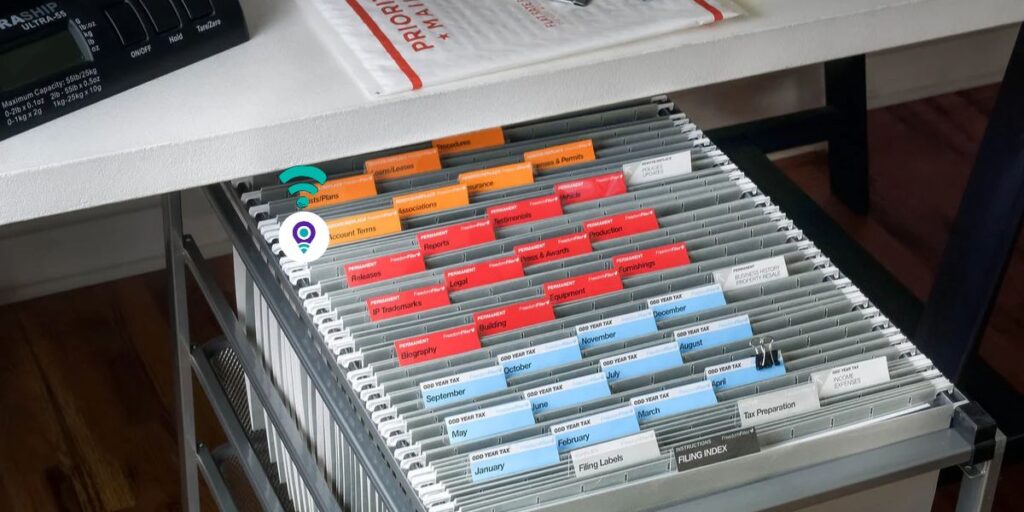
While RFID roll labels are superior for high-volume printing and automation, they do have a specific limitation: they do not support traditional color-coded side-tab filing.
The Trade-off
Color-coded systems (where labels wrap around a side tab) usually require specialized, multi-part sheeted labels to accommodate the color blocks and alpha-numeric characters. Roll labels are typically rectangular and applied to a flat surface.
When to choose roll labels:
- When automation and high-speed RFID encoding are the primary goals.
- When drawers or boxes store files rather than open-shelf side-tab systems.
- When the volume of new records being created daily requires a fast, automated print-and-encode workflow.
Encoding vs. Commissioning: What’s the Difference?
These two terms often cause confusion, but they represent different stages of the records management RFID lifecycle.
- Encoding: This happens at the printer. The printer writes data to the RFID chip as it creates the label. This is the standard for RFID roll labels.
- Commissioning: This happens at the software level. It is the act of “activating” a tag in the database. If you use a pre-printed/pre-encoded label, you must “commission” it by scanning it and telling the software which file it belongs to.
TrackerIoT supports both workflows. Our file tracking software can manage the real-time encoding of roll labels or the rapid commissioning of pre-printed tags, ensuring accurate location updates regardless of the labeling method.
How TrackerIoT Supports RFID Roll Label Workflows
TrackerIoT provides the “connective tissue” between the physical label and the enterprise database. We build our solutions to handle the complexities of modern IoT environments.
- Printer Integration: Our platform integrates directly with leading RFID thermal printers, allowing you to trigger a print-and-encode job directly from your records management interface.
- Real-Time Location Updates: Once an encoded roll label is applied, our fixed gateways and handheld readers provide instant visibility into the file’s status.
- Auditability and Compliance: Every time a roll label is scanned, a time-stamped entry is created. This provides a rigorous audit trail necessary for healthcare (HIPAA) and legal environments.
Industries That Benefit from RFID Roll Labels
Government and Public Records
For agencies managing millions of historical documents, the speed of RFID roll labels enables rapid tagging of backfiles. It also allows seamless integration of new intake.
Healthcare Archives
Medical records departments use roll labels to track patient charts and diagnostic films. The durability of thermal printing ensures that these labels remain readable for the entire retention period of the record.
Legal Document Storage
Law firms use RFID document tracking to manage the massive volume of discovery documents and case files. These files move between offices, courtrooms, and off-site storage.
The Future of RFID Roll Labels in File Tracking
As IoT technology evolves, we are seeing the rise of “Sensor-Enhanced” roll labels. Future iterations may include environmental sensors (for temperature or humidity) or “battery-assisted” tags for even longer read ranges.
The move toward data-driven records management means that the humble roll label is no longer just an ID tag; it is a data point that helps organizations understand their operational flow, reduce “lost file” costs, and improve service delivery times.
Conclusion
The success of an enterprise-scale file tracking system depends on the reliability of its labeling strategy. RFID roll labels and professional RFID encoding provide the speed, accuracy, and durability required to transform a manual archive into a high-performance digital asset.
At TrackerIoT, we help organizations navigate the complexities of RFID hardware and software. By implementing the right roll label workflows today, you are building a foundation for a more transparent, compliant, and efficient tomorrow.