
In the modern enterprise, the “paperless office” remains more of a goal than a universal reality. For government agencies, healthcare providers, and legal firms, physical documents remain a critical component of daily operations and regulatory compliance. However, as the volume of physical records grows, so does the complexity of managing them.
The challenge is no longer just storing files; it is knowing exactly where they are at any given millisecond. While RFID file tracking has revolutionized the industry by providing digital visibility, technology alone is often not a silver bullet. The most resilient, high-performance records management systems today utilize a hybrid approach: the precision of RFID color coded filing systems.
By integrating the automated data capture of TrackerIoT and FileTrackingIoT with the visual organization of color-coded folders, organizations can achieve a level of operational excellence that reduces misfiles to near zero while ensuring total compliance.
Why Traditional File Management Fails at Scale
Traditional filing systems—often relying on manila folders and manual out-cards—are inherently prone to human error. As an organization scales, these manual processes break down, leading to several critical failure points:
- The Search Cost: Employees spend an average of 18 minutes searching for a single document. In a high-stakes legal or medical environment, this is not just a loss of productivity; it is a liability.
- The Ghost File: A file that is physically present but improperly indexed or misplaced is effectively lost. Without a digital file tracking system, there is no “find my phone” equivalent for a critical contract or patient record.
- Compliance Gaps: Regulatory frameworks like HIPAA, GDPR, or CJIS require a strict chain of custody. Manual logs are easily falsified or forgotten, creating massive risks during an audit.
The growing need for visibility, speed, and accuracy has pushed organizations toward records management RFID solutions, but many soon realize that digital signals need to be paired with physical visual cues to be truly effective.
Why RFID Alone Is Not Enough: The Human Factor
RFID (Radio Frequency Identification) is a powerful tool. It allows a file tracking software to “see” through cabinet doors and locate files within a stack without line-of-sight scanning. However, RFID is a digital-first solution.
The “Human Factor” remains the most common point of failure in any records environment. An employee might pull five files, use them, and then return them to the wrong shelf. While the RFID system will eventually flag the file’s new location during a shelf audit, the immediate physical chaos of a disorganized filing room remains.
If a file is in the wrong place, the RFID system tells you where it is, but it doesn’t prevent it from being put there in the first place. This is where the synergy of RFID color-coded filing systems becomes essential.
The Role of Color-Coding in Filing Systems
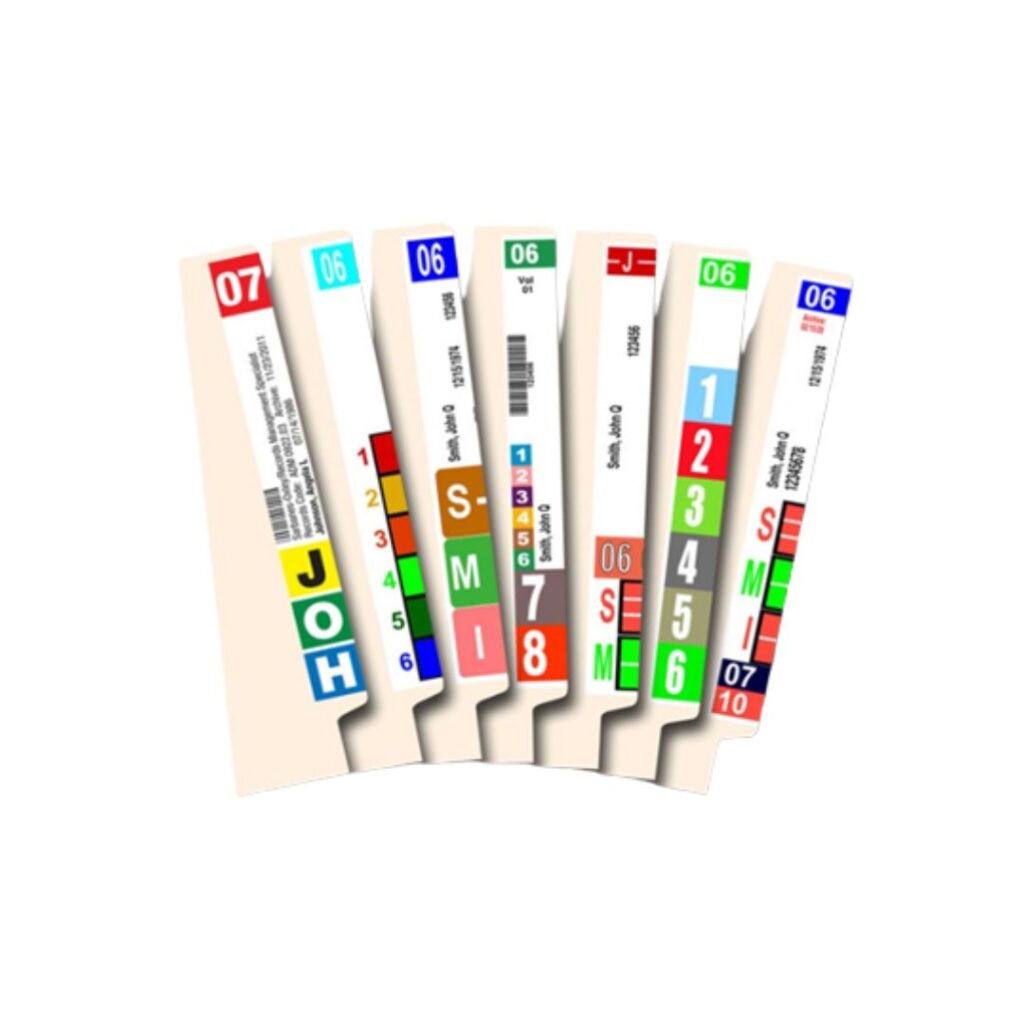
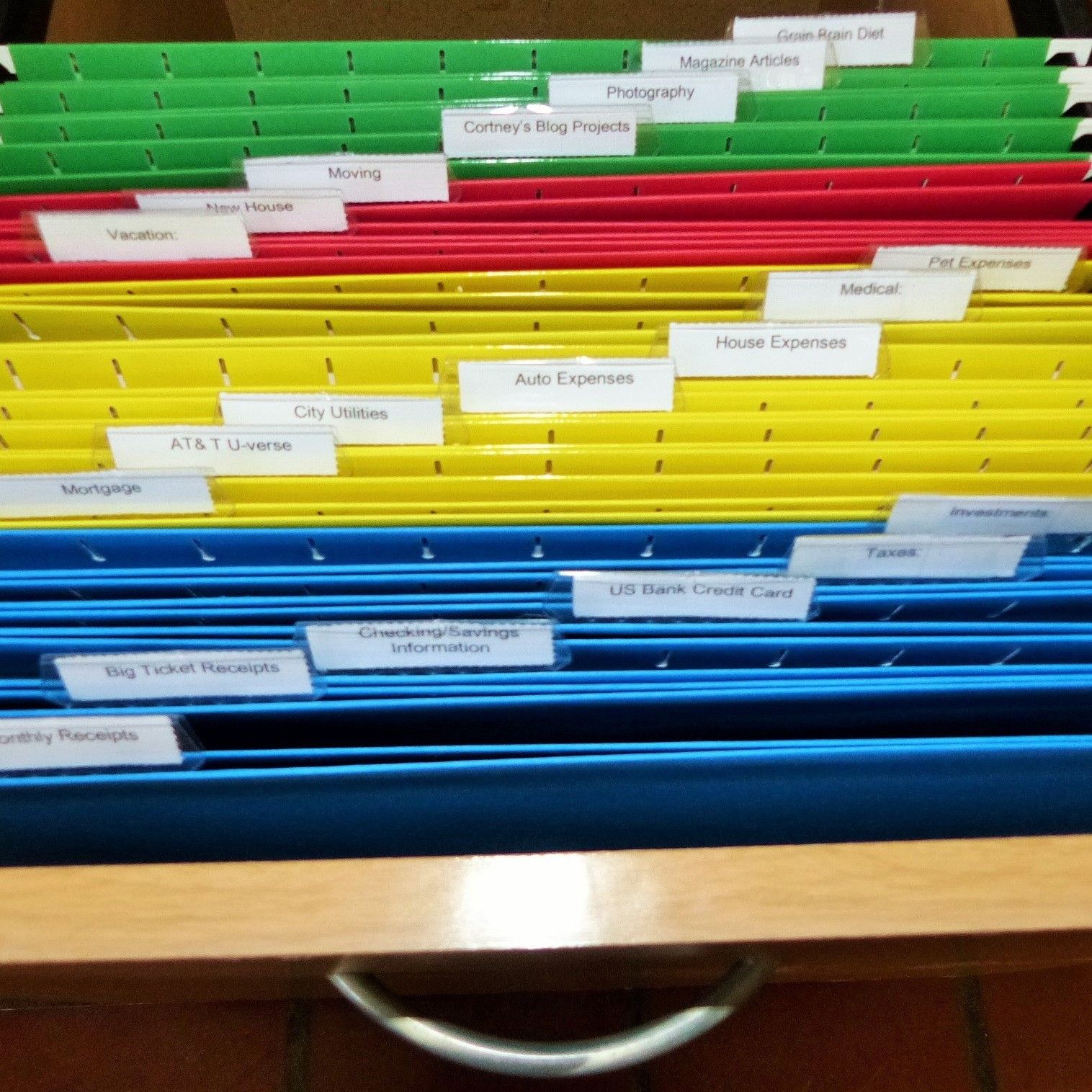
Color-coding is more than an aesthetic choice; it is a cognitive tool that leverages the brain’s ability to process visual patterns faster than text or numbers.
Visual vs. Cognitive Identification
When a clerk looks at a row of standard manila folders, they must read the text on every tab to find a specific record. This is a high-cognition task that leads to fatigue and errors. In contrast, a color-coded system assigns specific colors to letters or numbers (e.g., “A” is Red, “B” is Blue). The brain recognizes the color “Red” much faster than it reads the character “A.”
Reducing Errors and Retrieval Time
By using color-coded file folders, the retrieval process becomes a matter of pattern recognition. An experienced records manager can spot a “breaking” color pattern on a shelf from ten feet away, identifying a misplaced file instantly without ever pulling a folder.
Why RFID + Color-Coding Is Best Practice
When you combine RFID document management with color-coding, you bridge the gap between the physical and digital worlds. This “Best Practice” approach creates a multi-layered defense against data loss.
- Digital Precision: TrackerIoT sensors track the movement of files through doorways and between departments.
- Physical Integrity: Color-coded labels ensure that when a file is returned to the shelf, it is placed in its exact alpha-numeric home.
Real-World Efficiency
In a high-volume environment, such as a county clerk’s office, the combination allows for “hot-swapping” files. An employee can use a handheld RFID reader to locate a file’s general vicinity, and the color-coded tabs allow them to pluck the specific folder from the shelf in seconds.
Preventing Misfiles Before They Happen
The most significant benefit of RFID color-coded filing systems is the concept of “Visual Clash Detection.”
In a standard system, if file #405 is placed between #600 and #601, it stays there until someone happens to look for it. In a color-coded system, the color block for the “400s” will create a glaring visual break in the solid color block of the “600s.”
When you add RFID records management to this, the software can provide a secondary layer of protection. If a file is scanned into a “Zone” where it doesn’t belong, the file tracking software sends an immediate alert to the records manager’s dashboard. This proactive approach to file misplacement prevention saves hundreds of labor hours annually.
Open-Shelving & Side-Tab Color Coding
For many enterprises, space is a premium. Traditional drawer-based filing is inefficient, taking up vast amounts of floor space. RFID file tracking is most effective when paired with open-shelving systems and side-tab folders.
- High-Volume Efficiency: Side-tab folders allow for “at-a-glance” auditing. You don’t need to open a drawer to see what is inside.
- Space Utilization: Open shelving can store up to 50% more files in the same footprint as lateral drawers.
- IoT Integration: Open shelves can be equipped with fixed RFID antennas (Smart Shelves) provided by TrackerIoT, offering real-time inventory updates without manual scanning.
How TrackerIoT & IoTFileTracker Enhance RFID Filing Systems
At TrackerIoT and FileTrackingIoT, we don’t just provide tags; we provide a comprehensive ecosystem for file tracking for compliance. We design our solutions to modernize legacy filing systems into IoT-enabled assets.
Real-Time File Visibility
Our software integrates with fixed RFID gateways. As a color-coded file moves from the records room to an executive’s desk, the system updates the “Last Known Location” automatically.
Audit Trails and Compliance Readiness
For regulated industries, the ability to produce a historical audit trail is non-negotiable. Our system records every “touch” of a file. When a compliance officer asks, “Who had this file on October 12th?” the answer is available in two clicks.
Scalability and Enterprise Integration
Whether you are managing 5,000 files in a legal firm or 5 million in a state archive, our architecture scales. We provide the middleware that connects the physical RFID tag on a color-coded folder to your existing ERP or Document Management System (DMS).
Industries That Benefit Most
Government & Public Records
Managing chain of custody for sensitive documents is a matter of public trust. RFID file tracking ensures that vital records are never truly “lost.”
Healthcare
In a clinical setting, a missing patient chart can delay treatment. Color coded filing system helps nurses locate files quickly, and RFID tracks charts as they move between departments and labs.
Legal Firms
Legal discovery and case management require absolute precision. RFID records management prevents the “lost file” syndrome that can derail a trial or a closing.
Corporate Records
Large corporations use our systems to manage physical assets with the same rigor as digital data, from HR files to contracts.
The Future of RFID File Tracking: Data-Driven Operations
The future of records management is predictive. By analyzing the data collected by FileTrackingIoT, organizations can identify bottlenecks. For example, if the system shows that files frequently “stall” in the legal department, management can allocate more resources to that area.
We are moving toward a world where the file room isn’t just a storage area—it’s a data source. Intelligent RFID color-coded filing systems provide the transparency needed to turn physical archives into streamlined, high-efficiency operations.
Conclusion: The Best of Both Worlds
To achieve true records management optimization, you cannot rely on technology or human organization in isolation. The synergy of RFID color-coded filing systems provides a failsafe environment where files are easy to find, impossible to lose, and simple to audit.
By combining the visual intelligence of color-coding with the automated power of TrackerIoT and FileTrackingIoT, you ensure that your organization remains compliant, efficient, and ready for the future.