
In the world of enterprise records management, visibility is the currency of efficiency. For organisations managing thousands—or millions—of physical documents, the transition from manual logs to an automated RFID file tracking system is a transformative leap. However, the success of that transition rests entirely on the foundational layer of the system: the RFID label.
At TrackerIoT, we view the RFID label not just as a sticker, but as a digital twin of a physical asset. Proper RFID label printing, commissioning, and application are the critical stages where physical records are officially “onboarded” into the digital ecosystem. Without a rigorous, scalable approach to these processes, even the most advanced file tracking software will struggle with data integrity and operational gaps.
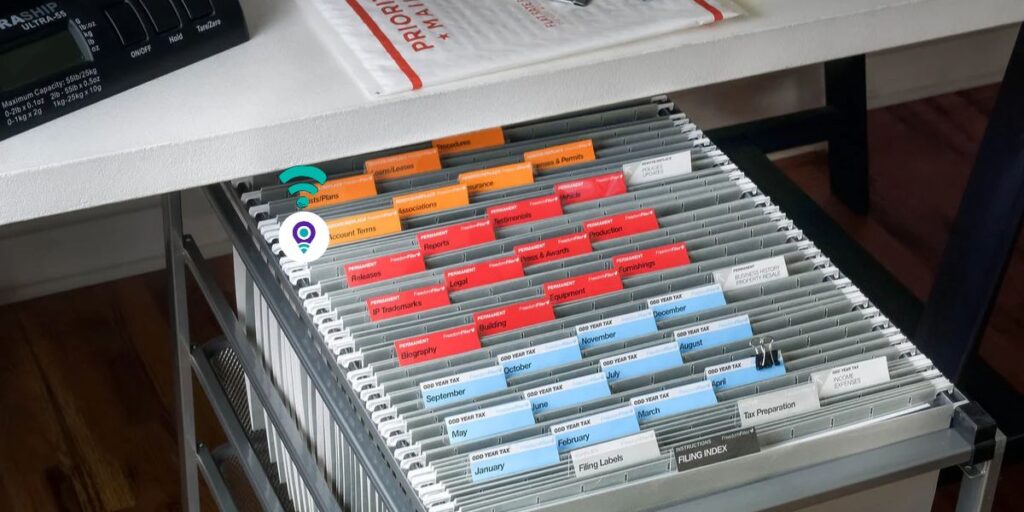
Why RFID Labelling is Foundational to Successful File Tracking
A file tracking system is only as reliable as its data capture. In high-stakes environments like government agencies, healthcare systems, and legal firms, “close enough” is not an option for document location. RFID technology allows for non-line-of-sight identification, meaning a clerk can find a specific folder buried in a stack or located behind a cabinet door.
For this “magic” to work, staff must print the label correctly, encode it with unique data, and apply it to ensure long-term durability. This process forms the cornerstone of compliant file tracking, recording every document movement in an immutable audit trail.
Why RFID Labels Matter in File Tracking Systems
To understand the importance of the labelling process, one must understand the relationship between the hardware and the software. An RFID system consists of three main components:
- The RFID Tag: The physical chip and antenna embedded in the label.
- The RFID Scanner: Fixed gateways or handheld readers that emit radio waves.
- The File Tracking Software: The brain (like TrackerIoT) that interprets the signals and manages the database.
If staff print a label poorly or commission it incorrectly, they break the connection between the physical folder and the digital record. Accurate identification at the source prevents “ghost files”—records that exist in the database but cannot be found on the shelf, or vice versa.
RFID Label Printing: What Organizations Need to Know
When planning an enterprise-scale rollout, organisations must choose between two primary paths: RFID labelling services (pre-printed/pre-encoded labels) or in-house printing.
Label Types and Durability
Unlike standard barcodes, RFID labels contain sensitive electronic components. For records management RFID, labels must be:
- Durable: Able to withstand years of handling and shelving.
- Flexible: Designed to wrap around folder tabs without damaging the internal antenna.
- Optimised: Tuned for the specific environment (e.g., labels used in proximity to metal shelving require different configurations than those used in standard cardboard boxes).
Printing at Scale vs. Ad-Hoc Labelling
For a “Day One” conversion where an entire file room is being modernised, bulk RFID label printing is the standard. This involves high-speed industrial printers that can encode the RFID chip and print the human-readable text and barcodes simultaneously. For “Day Two” operations (new files created daily), desktop RFID printers integrated with your file tracking software allow for seamless, on-demand labelling.
RFID Commissioning Explained: The Digital Handshake
In the industry, we often hear “printing” and “commissioning” used interchangeably, but they are distinct processes. RFID commissioning is the act of associating a specific, unique RFID Tag ID (the Electronic Product Code or EPC) with a specific record in your database.
Why Commissioning is Critical
Without commissioning, an RFID tag is just a random number. The commissioning process ensures that when the TrackerIoT software sees Tag E280-1105-0000, it knows it is looking at “Case File #8829 – Johnson vs. State.”
Preventing Data Mismatches
The greatest risk in any RFID deployment is a data mismatch—where Tag A is applied to File B. Best practices involve using “Print and Encode” workflows where the software verifies the chip’s internal ID immediately after printing the label, ensuring a 1:1 match between the physical print and the digital encoding.
Best Practices for Applying RFID Labels to Existing Files
Applying labels to an existing inventory (a “backfile conversion”) is often the most labour-intensive part of the project. To minimise disruption, TrackerIoT recommends the following strategies:
1. Applying Labels During Circulation
For organisations that cannot afford a total shutdown, “Labelling on Discovery” or “Labelling during Circulation” is effective. When a file is requested or handled, it is labelled and commissioned before being returned to the shelf. Over time, the most active—and therefore most important—files are tagged first.
2. Batch vs. Individual Labelling
Batch labelling involves taking a specific section of the file room (e.g., all files starting with “A”) and processing them as a group. This is generally more efficient than individual labelling as it allows for a “production line” workflow.
In-Place Label Application for Operational Efficiency
One of the most significant logistical hurdles is moving files to a workstation for labelling. In-place label application uses a modern approach that reduces risks when staff relocate documents.
By using mobile RFID commissioning carts equipped with a laptop, an RFID printer, and a handheld scanner, staff can move through the aisles. Staff pull files from the shelf, label them, scan them, and return them immediately. This process reduces the risk of lost files during conversion and eliminates heavy lifting and moving massive carts of “untracked” paper through the building.
Converting Existing File Folders Without Replacement
A common misconception is that you must buy new, RFID-embedded folders to upgrade your system. In reality, most organisations prefer to keep their existing folders—especially if they use specialised colour-coded systems.
Side-Tab and Conversion Tab Strategies
For open-shelving systems, labels are often applied as “wraparound” tabs. These conversion tabs adhere to the existing side-tab of the folder. This allows the RFID antenna to sit on the edge of the folder, providing the best possible read range for handheld scanners passing down the aisle.
Supporting Open Shelving Systems
Staff should apply RFID labels consistently in the same position on every folder. This uniformity enables “rapid-fire” scanning and prevents the folder contents or neighboring files from blocking the RFID signal.
Sequencing and Schema Alignment
A disorganised RFID deployment is simply an expensive version of a disorganised manual system. Sequencing refers to the order in which files are labelled and entered into the system.
If your current filing system is alphabetical, your RFID commissioning should follow that same schema. This ensures that the digital “map” created by TrackerIoT matches the physical reality of your file room. We recommend using a sequence that incorporates:
- The Primary Identifier: (e.g., Account Number, Case ID, or Social Security Number).
- A Check Digit: To prevent manual entry errors during the commissioning phase.
How TrackerIoT Supports RFID Labelling & File Tracking
TrackerIoT provides more than just software; we provide a holistic framework for enterprise visibility. Our platform is designed to handle the complexities of large-scale labelling and commissioning.
- Integrated Commissioning: Our software connects directly to industrial RFID printers, automating the link between your database and the RFID tags.
- Real-Time Audits: Once labelled, files can be audited in minutes using our handheld RFID workflows. What used to take a week of manual “shelf-reading” now takes an hour.
- Compliance Ready: TrackerIoT generates detailed reports on every labelled asset, providing the chain-of-custody documentation required by HIPAA, CJIS, and other regulatory bodies.
- Scalability: From a single records room to a global enterprise with dozens of locations, our system manages the printing and tracking of millions of labels without performance degradation.
Industries That Benefit Most
Government and Public Records
Managing the chain of custody for sensitive government documents is a matter of public trust and legal requirement. RFID labelling ensures that vital records are never “missing” when a FOIA request or audit occurs.
Healthcare and Patient Records
Despite the rise of EMRs, physical charts, lab results, and diagnostic images still exist. RFID document tracking ensures these critical items are available at the point of care.
Legal and Compliance-Driven Organisations
For law firms, a missing case file can mean a missed deadline or a lost trial. RFID labelling services ensure that staff account for every document.
The Future of RFID Labelling in Records Management
The next frontier of records management, RFID, is the “Smart Room.” As labelling becomes more standardised, we are seeing the rise of overhead RFID sensors that track file movement in real-time without any human intervention.
Furthermore, the data generated from these labels is allowing organisations to move toward “Data-Driven Operations.” By analyzing file usage and dwell times, managers optimize their records center layout to reduce labor costs and speed up retrieval.
Conclusion
The transition to a modern RFID file tracking system is a journey that begins with a single, well-printed label. By adhering to best practices in RFID label printing, commissioning, and application, organisations can eliminate the chaos of misplaced files and the risks of non-compliance.
TrackerIoT helps enterprises bridge the gap between physical archives and digital workflows. Whether you are looking for a full-scale RFID labelling service or the software to manage your own in-house operations, we provide the tools and expertise to ensure your records are always visible, always accounted for, and always compliant.