
In the modern enterprise, information security is often synonymous with firewalls and encryption. Yet, for government agencies, healthcare providers, and legal firms, some of the most sensitive data remains housed in physical folders. While digital assets are protected by layers of virtual security, physical records are frequently vulnerable to the simplest of threats: someone walking out the door with them.
The risk of unauthorized file removal—whether accidental or intentional—represents a significant gap in many records management programs. To close this gap, organizations must extend their security perimeter to the physical threshold. By implementing RFID doorway security and RFID exit security zones managed by the IoTFileTracker platform, enterprises can transform passive passageways into intelligent security checkpoints that enforce compliance in real-time.
Why Physical Records Remain Vulnerable at Exits and Passageways
Most organizations manage their files with a “trust but verify” model. Files are checked out to authorized personnel, and it is assumed they will remain within the secure confines of the office. However, without active monitoring at exit points, this model relies entirely on human memory and intent.
The Risk of Unauthorized File Removal
Unauthorized removal occurs in two primary forms:
- Accidental Removal: An employee inadvertently carries a sensitive file out of the building in a briefcase or among personal belongings.
- Intentional Breach: An insider removes restricted documents with the intent to disclose or misappropriate the information.
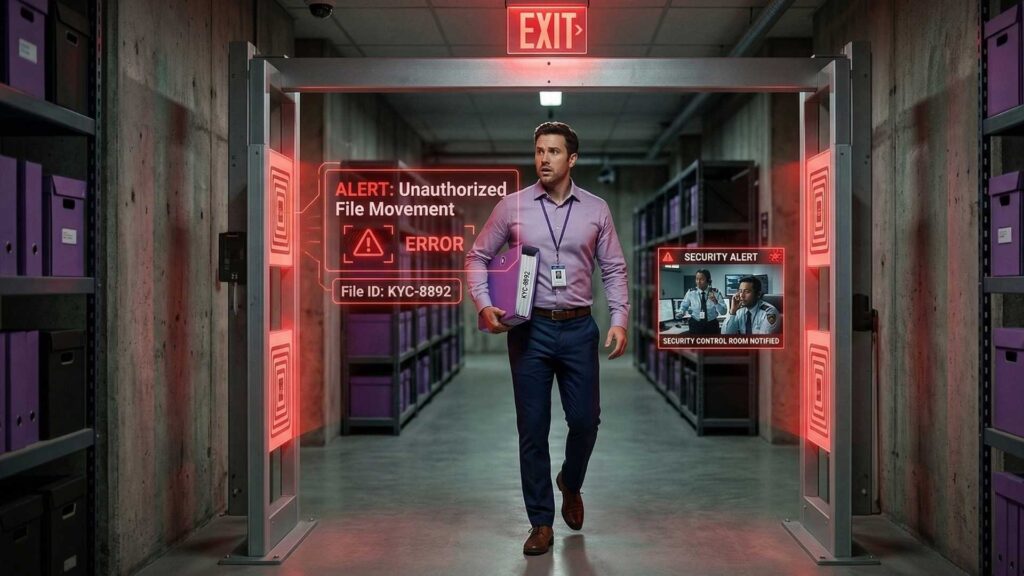
In both scenarios, the lack of file tracking security at the doorway means the organization may not realize the record is missing for days, weeks, or even months—often only when an audit or an urgent request reveals the “black hole” in the inventory.
What Are RFID Doorway and Exit Security Zones?
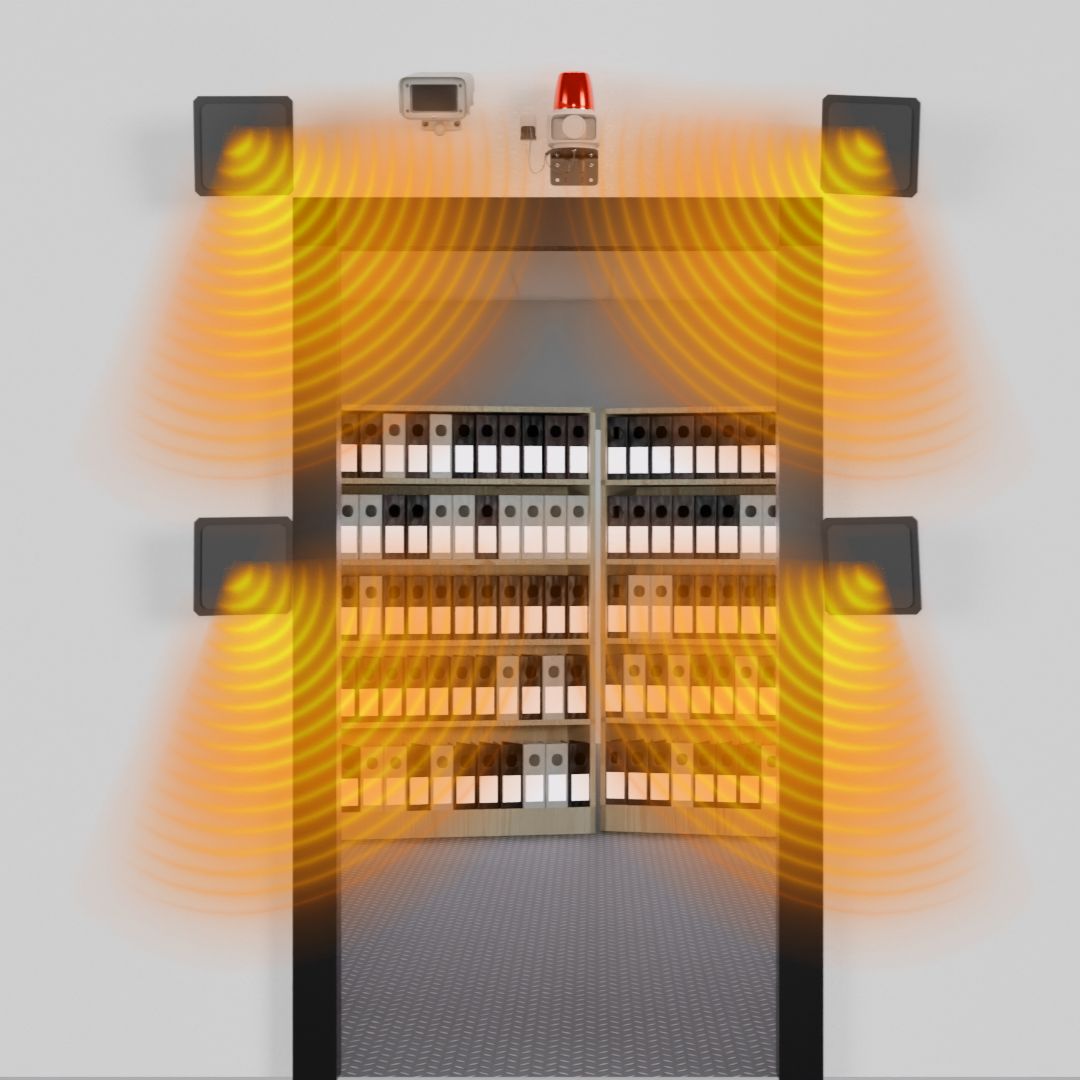
RFID exit security zones are localized detection areas created by strategically placing RFID readers and antennas at doorways, elevators, and facility exits. These zones are designed to “interrogate” any RFID-tagged folder that passes through the threshold.
Tracking vs. Security Enforcement
While standard RFID file tracking focuses on where a file is (inventory), RFID doorway security focuses on whether a file is allowed to be there. IoTFileTracker serves as the centralized logic engine that distinguishes between a routine file transfer and a security breach. It enforces security protocols at the very second the threshold is crossed, moving the organization from reactive searching to proactive prevention.
Why Doorways and Exits Are the Highest-Risk Points
In any facility, there are specific “choke points” where the risk of loss is highest:
- File Rooms and Registries: The transition point where a record moves from a controlled storage environment into the general office space.
- Facility Exits: The final boundary between a secure building and the public domain.
- Archives and Restricted Areas: Zones housing long-term records or highly classified materials that should never leave a specific room.
By securing these specific points, IoTFileTracker ensures that the chain-of-custody tracking remains unbroken, even when the human element fails.
Using RFID as a Stand-Alone Security Layer
For many organizations, the first step in physical records security is the deployment of stand-alone RFID detection. This involves installing high-gain antennas that create a 3D “read field” at the doorway.
As a tagged file approaches the exit, the reader identifies the unique ID of the folder and checks its status against the IoTFileTracker database. If the file is not marked as “Authorized for Removal” or “Checked Out to Courier,” the system triggers an immediate response. This provides a dedicated layer of protection that operates independently of—but complementary to—standard facility security.
Integrating RFID with Security Systems
To achieve a true “Defense-in-Depth” posture, IoTFileTracker is designed to integrate with existing building security infrastructure.
- Video Surveillance: When an unauthorized file removal is detected, IoTFileTracker can trigger a bookmark or an alert in the Video Management System (VMS), allowing security teams to see exactly who was carrying the file.
- Access Control: The system can be integrated with badge readers. If a person attempts to leave with a file they are not authorized to possess, their badge can be temporarily flagged.
- Door Locks: In high-security environments, the detection of a restricted file can trigger an electromagnetic lock to prevent the door from opening.
RFID Security Protocols in IoTFileTracker
The power of IoTFileTracker lies in its rule-based alerting engine. Not every movement is a breach, and the system is designed to handle complex records management compliance rules:
- Authorized Movement: A file is checked out to an employee and is permitted to move between Floor 1 and Floor 2, but not through the Main Lobby exit.
- Unauthorized Movement: A “Restricted” classification file is detected leaving the legal department.
- Time-Based Rules: Files that are authorized for removal during business hours may trigger alerts if they are detected at an exit after 6:00 PM.
Alerts and Real-Time Responses
When a security protocol is violated, IoTFileTracker initiates a multi-tiered response:
- Audible Alarms: A siren or chime at the doorway provides immediate notification to the individual and nearby staff.
- Flashing Lights: Visual indicators (Red/Green light stacks) provide an unambiguous signal of a security event.
- Digital Notifications: Instant alerts are sent to security and records managers via the IoTFileTracker dashboard, email, and SMS, ensuring that the right people are informed regardless of their location.

File Room and Registry Doorway Security
Securing the internal registry is just as important as securing the building exit. IoTFileTracker deployments often include motion sensors at file room doors to determine “Direction-of-Travel.”
By understanding if a file is entering (returning to storage) or exiting (leaving for use), the system can automatically update the file status. If a file exits without a corresponding digital checkout at a workstation, it is flagged as an unauthorized movement, preventing the registry from becoming a source of unrecorded “leakage.”
Audit Trails and Security Event Logging
Every time a file passes through an RFID doorway security zone, a permanent record is created in IoTFileTracker. These logs include:
- The unique File ID and description.
- The specific doorway or exit used.
- The exact time and date (down to the second).
- The alert status (Authorized vs. Unauthorized).
This immutable audit trail is essential for records management compliance, providing the documented evidence required during regulatory reviews or internal investigations.
Reconciling RFID Events with Video Footage
One of the most effective ways to strengthen accountability is through the correlation of RFID data and video. If a file is missing, a manager can query IoTFileTracker for the last time that file was detected at an exit.
By matching the RFID timestamp with the facility’s camera footage, the organization can identify the “person-of-interest” with 100% certainty. This significantly reduces the time required for investigations and serves as a powerful deterrent against future unauthorized removals.
Typical Doorway RFID Security Architecture
A standard IoTFileTracker security zone consists of:
- Network-Connected Readers: Capable of processing hundreds of tags simultaneously.
- Multiple Antennas: Often 2 to 4 per doorway to ensure files are detected regardless of their orientation (e.g., inside a briefcase or under a coat).
- Integrated Peripherals: Motion sensors for travel direction and light stacks for visual alerting.
Operational and Compliance Benefits
Implementing RFID doorway security delivers a measurable return on investment:
- Reduced File Loss: Early detection prevents files from leaving the facility.
- Stronger Chain-of-Custody: Every “hand-off” and “pass-through” is recorded.
- Improved Audit Readiness: Provides verifiable proof that the organization maintains control over physical records.
Industries That Benefit Most from RFID Doorway Security
- Government & Public Records: Preventing the removal of classified or sensitive investigative files.
- Healthcare: Ensuring patient charts (PHI) remain within secure clinical zones to maintain HIPAA compliance.
- Legal & Judicial: Protecting evidence and discovery materials from leaving the secure law library.
- Enterprise: Securing intellectual property, original contracts, and HR files in shared office environments.
Conclusion
The threshold of a doorway should not be the point where visibility ends. In a modern records management strategy, doorways must be the points where security is most active. RFID doorway security managed by IoTFileTracker provides the proactive alerts and immutable audit trails necessary to protect your organization’s most valuable physical assets.
By enforcing security protocols at the point of action, TrackerIoT ensures that your records are not just tracked—they are truly secure.