In the high-stakes world of enterprise information governance, the complexity of a record often exceeds the capacity of a single manila folder. Whether it is a massive litigation case spanning years, a multi-decade employee history, or a complex government project, the data involved is rarely a “flat” collection of papers. It is a hierarchical ecosystem.
When organizations fail to account for this hierarchy in their physical records management, the result is “folder bloat”—overstuffed, unorganized containers that make document retrieval a labor-intensive nightmare. To solve this, sophisticated records managers employ a Master Folder and Sub-Folder methodology. By leveraging IoTFileTracker, organizations can digitize this physical hierarchy, ensuring that every layer of the record is visible, trackable, and compliant.
Why Folder Hierarchy Matters in Records Management
At its core, a filing system must be intuitive. If a records manager has to search through a four-inch thick “Project A” folder to find one specific contract, the system has failed.
The Risks of Flat Filing Systems
In a flat system, every document related to a subject is dumped into one container. This leads to:
- Information Lag: Critical documents are physically present but hidden within a mass of paper.
- Physical Degradation: Overstuffed folders tear, sag on shelves, and eventually damage the very documents they are meant to protect.
- Compliance Gaps: If you cannot quickly prove that a specific sub-document (like a signed HIPAA consent) is present within a larger patient record, you are at risk during an audit.
Structuring records with master and sub-folders is one of the most effective records management best practices for ensuring scalability and rapid access.
What Are Master Folders and Sub-Folders?
The Master/Sub-Folder structure is a “Parent-Child” relationship applied to physical media.
- The Master Folder (Parent): A robust container that acts as the primary anchor for a specific entity (e.g., a Client, an Employee, or a Project).
- The Sub-Folder (Child): Smaller, specialized folders nested inside the Master Folder that categorize specific aspects of that entity (e.g., “Correspondence,” “Financials,” “Legal Pleadings”).
This structure allows for “granular visibility.” You can track the movement of the entire Master Folder, or you can track a specific Sub-Folder as it moves independently between departments.
Expandable Pocket Folders as Master Folders
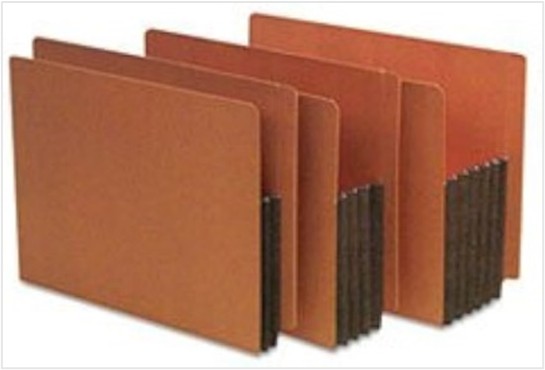
For a Master Folder to be effective, it must be physically capable of housing several sub-folders without collapsing. Expandable pocket folders (often made of durable “Redrope” or heavy pressboard) are the industry standard for this role.
These folders feature accordion-style gussets that allow them to expand as the record grows. Because they are enclosed on the sides, they prevent sub-folders from sliding out during transit. When integrated with IoTFileTracker, these Master Folders serve as the primary “Smart Container,” often carrying the primary RFID tag that identifies the entire case or file set.
Common Use Cases for Master Folder Structures
Law Firms: Clients and Matters: In legal physical records management, a “Client” is the Master, and each “Matter” (specific case) is a Sub-Folder. For complex litigation, a single Matter might further be broken down into Sub-Folders for “Discovery,” “Transcripts,” and “Exhibits.”
Employee and HR Records: An HR Master Folder contains the employee’s entire history. Sub-folders separate “Payroll/Tax,” “Performance Reviews,” “Benefits,” and “Medical/HIPAA” records. This allows a manager to review a performance file while keeping sensitive medical or salary data protected.
Labeling and Indexing Master Folders and Sub-Folders
A hierarchical system requires a dual-level labeling strategy. IoTFileTracker standardizes this process to prevent indexing errors.
- Master Folder Labeling: Typically side-tabbed for open-shelf visibility. It carries the primary identifier (e.g., “Account #8829 – Global Corp”).
- Sub-Folder Labeling: These are often top-tabbed or color-coded to indicate their category.
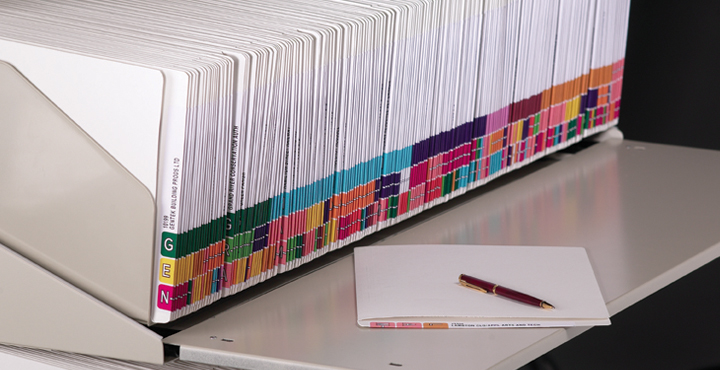
By using color-coded filing systems for sub-folders (e.g., all “Financial” sub-folders are Green, all “Legal” are Red), staff can visually confirm that a Master Folder contains all its necessary components at a glance.
Using Barcodes and RFID with Master and Sub-Folders
This is where IoTFileTracker transforms a physical filing method into a high-tech tracking solution. The platform allows for “Hierarchical Tagging.”
Inherited vs. Independent Location Tracking
- Independent Tracking: You can apply a unique RFID tag to every sub-folder. This works best when different teams frequently check out sub-folders, such as the accounting team taking the “Financial” sub-folder while the legal team takes the “Contracts” sub-folder.
- Inherited Tracking: If the sub-folders rarely leave the Master Folder, you only tag the Master. IoTFileTracker assumes that if the Master is on Shelf A, all its children are there too.
This flexibility ensures that your file tracking system matches your actual operational workflow.
Partitioning Sub-Folders for Deeper Organization
For even greater detail, sub-folders can be further divided using internal partitions or fasteners. IoTFileTracker can manage these levels as well. Partition folders with built-in dividers allow you to secure documents in chronological order, creating a “book-like” experience for the user. This level of file folder organization is essential for legal and compliance records where the order of documents is a matter of evidentiary integrity.
One of the greatest benefits of a hierarchical system is its ability to handle growth. Instead of a folder becoming unmanageable, you simply add a new sub-folder.
IoTFileTracker helps monitor this growth. By tracking the “volume” or “thickness” of files in the digital registry, records managers can receive alerts when it is time to transition a record to long-term records archives or to split a Master Folder into Volume 1 and Volume 2.
How IoTFileTracker Supports Hierarchical Folder Tracking
IoTFileTracker specifically manages “Parent-Child” relationships.
- Visibility into Circulation: If someone requests a sub-folder, the system shows that the Master Folder is “Incomplete” on the shelf and identifies exactly who has the missing child folder.
- Audit Readiness: During a compliance audit, you can generate a report that tracks the complete history of every sub-folder, ensuring staff do not lose or tamper with any part of the record.
Productivity and Compliance Benefits
Implementing a Master/Sub-Folder system through IoTFileTracker delivers a measurable ROI:
- Faster Access: Staff go directly to the specific sub-folder they need, rather than digging through a mountain of paper.
- Reduced Misfiles: Clearer hierarchy leads to fewer “orphaned” documents sitting on desks.
- Improved Governance: It enforces a “need-to-know” security model by allowing you to control access at the sub-folder level.
Industries That Benefit Most
- Government & Judicial: Managing complex case files where multiple departments (prosecution, defense, social services) need access to different parts of the same record.
- Healthcare & HR: Protecting privacy by separating general administrative files from sensitive personal data.
- Enterprise Projects: Tracking long-term construction, engineering, or research projects where documentation is voluminous.
Best Practices for Implementing Master Folder Systems
To succeed, organizations should follow these three steps:
- Standardize the Taxonomy: Define exactly what sub-folders every Master Folder must contain.
- Align Physical and Digital: Ensure your IoTFileTracker categories match your physical drawer or shelf labels.
- Training: Ensure staff understand that a document belongs in a specific sub-folder, not just “the big folder.”
Conclusion
Hierarchical folder structures are the secret to scalable physical records management. By breaking down complex records into Master and Sub-Folders, organizations can eliminate the chaos of “flat” filing. When these physical best practices are managed by IoTFileTracker, you gain a powerful, auditable, and highly efficient file registry system.
IoTFileTracker by TrackerIoT provides the visibility and control required to manage your most complex records with total confidence.