In the lifecycle of a high-value document, the most vulnerable moment occurs during the transition of possession. Whether a case file is moving from a records room to an attorney’s office, or a patient chart is transitioning between clinical departments, the hand-off is where visibility often fails. For decades, organizations relied on manual logbooks—paper-based systems where a scrawled signature was the only proof of transfer.
In today’s regulatory climate, these legacy methods are no longer sufficient. Organizations now require a “Digital Handshake” that is immutable, time-stamped, and legally defensible. By integrating electronic signature file tracking with the IoTFileTracker platform, TrackerIoT has modernized the concept of the “Chain of Custody,” turning physical file transfers into secure, audited, and transparent digital events.
The Importance of Chain-of-Custody in Records Management
In records management, chain of custody tracking is the chronological documentation or paper trail that records the sequence of custody, control, transfer, and analysis of physical records. It is the primary mechanism for establishing accountability.
Accountability, Compliance, and Risk Mitigation
Without a verifiable chain of custody, an organization cannot prove who had a document at a specific time. This creates a massive liability in several areas:
- Legal Discovery: If a document is missing or altered during litigation, the lack of a custody trail can lead to spoliation of evidence charges.
- Regulatory Audits: Agencies governed by HIPAA, CJIS, or Sarbanes-Oxley must prove that sensitive information was only accessible to authorized personnel.
- Operational Risk: Lost files result in hundreds of wasted labor hours and delayed decision-making.
IoTFileTracker ensures that the chain of custody is not just a secondary log, but a foundational requirement for every file movement.
Manual vs. Digital File Transfer-of-Custody
The inherent failures of paper-based sign-out books drive the transition from manual to digital workflows.
Problems with Handwritten Signatures
Handwritten logs suffer from several critical flaws:
- Illegibility: Signatures are often unreadable, making it impossible to identify the recipient months later.
- Lack of Verification: There is no real-time check to see if the person signing is actually authorized to receive the file.
- Data Fragmentation: A paper log stays in the file room; it does not update the organization’s central database or notify the records manager of a late return.
- Audit Fragility: Paper logs can become lost, damaged, or altered, which makes them useless during a formal audit.
By contrast, a digital file transfer of custody via IoTFileTracker is instant, legible, and synchronized across the entire enterprise.
What Is Electronic Signature Capture in File Tracking?
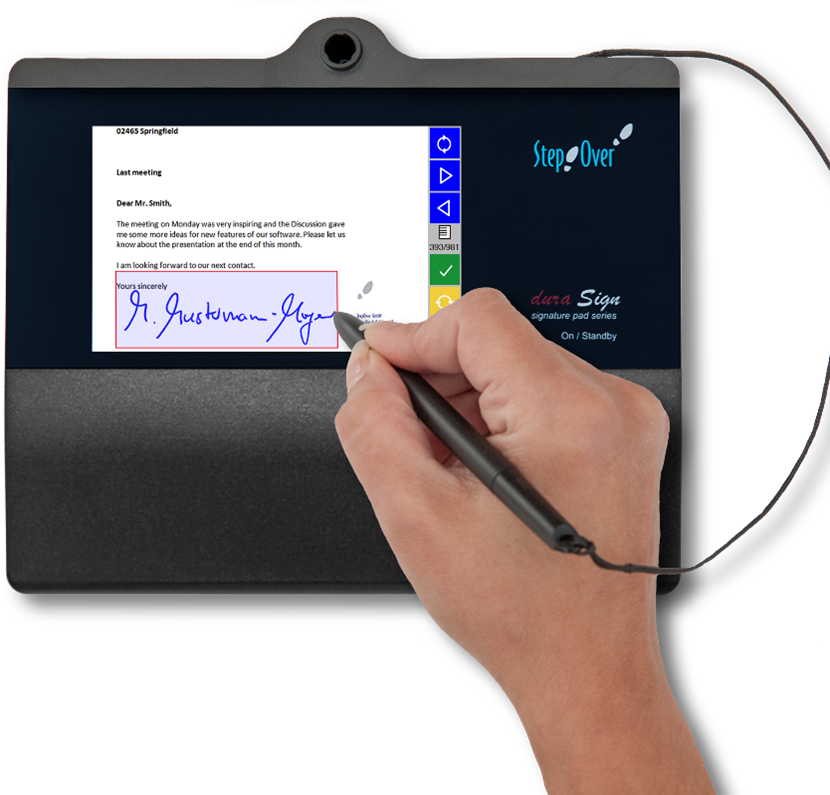
Electronic signature capture is the process of using digital input—such as a signature pad or a touchscreen—to record an individual’s acknowledgement of receipt. In a secure file checkout workflow, the electronic signature serves as a “Receipt-of-Custody.”
When a user signs for a file, they are not just marking a name; they are creating a digital bond between their verified identity and the specific RFID tag on the folder. This process forms the cornerstone of records management security and ensures users explicitly accept responsibility rather than passively assume it.
How File Check-Out Works in IoTFileTracker
IoTFileTracker designs the check-out process to remain operationally practical while maintaining maximum security.
Requesting and Transferring Files
- Identification: The recipient identifies themselves at the records kiosk using a badge scan or secure login.
- Retrieval: The records manager uses RFID file tracking to locate the requested file instantly.
- Verification: The system confirms the recipient is an authorized user for that specific file classification.
- Check-Out: The system scans the file’s RFID tag and prompts for the transfer of custody.
Once the system captures the signature, IoTFileTracker updates the file status from “In File Room” to “With [Recipient Name]” and provides real-time location visibility to all authorized stakeholders.
Capturing Electronic Signatures at Transfer
The actual moment of signature is where the “Digital Handshake” occurs. IoTFileTracker supports various hardware interfaces, including dedicated electronic signature pads and mobile tablets.
Verifying Recipient Acceptance
When the recipient signs the pad, the software captures a high-resolution image of the signature and attaches it to the transaction record. This step forces a moment of deliberate accountability. The recipient is acknowledging:
- They have physically received the file.
- The file is complete and intact (validated by an RFID scan).
- They are now the primary custodian responsible for its security and eventual return.
Automatic Audit Trail Creation
The most powerful feature of IoTFileTracker is what happens behind the scenes. Every time a signature is captured, the system generates an automatic, time-stamped audit trail for records.
Linking File, Recipient, and Signature
The database creates a secure entry that includes:
- The unique RFID Tag ID.
- The Recipient’s System ID and Profile.
- The exact date and time (to the second).
- The digital signature image.
- The location of the transfer station.
This record is immutable. It cannot be edited or deleted, providing the “Source of Truth” required for file tracking for compliance.
File Returns and Ongoing Custody Tracking
The chain of custody doesn’t end when the file is checked out; it must also be closed when the file is returned. IoTFileTracker manages the return workflow with equal rigor.
Upon return, the records manager scans the file, and the system automatically updates the status to “Returned.” In high-security environments, the system can require the records manager to sign off on the return and confirm that the file is in good condition. This process maintains a continuous, unbroken history of custody from the moment a record is created until its destruction.
Reporting and Chain-of-Custody History
For records managers and compliance officers, the ability to generate “Custody Reports” is invaluable. IoTFileTracker allows administrators to view the full lifecycle of a record with a single click.
If a file is missing, the manager can pull a report showing every person who has signed for that file over the last five years. This level of document accountability makes investigations straightforward and data-driven, rather than relying on guesswork and memory.
Security and Compliance Benefits
Implementing electronic signatures through IoTFileTracker offers profound benefits for the modern enterprise:
- Reduced Disputes: There is no “I never took that file” when a digital signature and badge-scan record exist.
- Stronger Governance: It enforces organizational policy at the point of action.
- Enhanced Audit Readiness: You remain prepared for any unannounced inspection or internal audit.
- Loss Prevention: Employees are significantly more careful with files when they know their signature is digitally tied to the record’s location.
The Future of Secure File Custody Management
As we move toward a digital-first records governance model, the integration of physical and digital security will only deepen. We anticipate a future where biometric verification—such as fingerprint or facial recognition—will work alongside electronic signatures to provide even higher levels of certainty. IoTFileTracker is built on a scalable architecture, ready to integrate these emerging technologies as the standards for secure file checkout continue to evolve.
Conclusion
In the pursuit of operational excellence and total compliance, “good enough” tracking is no longer an option. Electronic signatures provide the definitive proof of possession that manual systems lack.
By choosing IoTFileTracker, you are not just buying a software platform; you are implementing a culture of accountability. Our system ensures that your physical records are managed with the same rigor and security as your digital ones, protecting your organization’s integrity at every step of the way.