
In an era defined by digital transformation, it is easy to assume that physical records have become a secondary concern. However, for government agencies, healthcare systems, and legal firms, the physical file remains a critical “source of truth.” The challenge facing these organizations is not the existence of paper, but the inefficiency of traditional filing methods.
Poorly designed filing systems are more than just an organizational nuisance; they are a direct drain on productivity and a risk to compliance. When a file is misplaced, the search cost ripples through the organization—delaying legal proceedings, impacting patient care, or stalling public services. At TrackerIoT, we believe the solution lies in a hybrid approach: combining the visual intelligence of color-coded filing systems with the digital precision of IoTFileTracker.
What Is a Color-Coded Filing System?
A color-coded filing system is a methodology that uses specific colors to represent letters or numbers within a file’s index. Instead of a clerk reading a small, typed name on a tab, they identify the record through a distinct pattern of color blocks.
Typically, this involves assigning a unique color to each digit (0–9) or each letter of the alphabet (A–Z). When folders are arranged in a file tracking system, these colors create solid bars of color. If a file is out of sequence, the color bar is broken, creating an immediate visual “clash.”
Why Consistent File Folder Indexing Is Critical
Standardization is the cornerstone of records management best practices. Without a consistent indexing schema, a file registry becomes a chaotic environment where “Smith, John” might be filed under S, J, or even a random case number.
Productivity Impact
Consistency allows for rapid retrieval. When every folder follows the same file folder indexing rules, staff spend less time deciphering handwritten notes and more time processing records.
Error Reduction and Cost Control
Inconsistent indexing leads to duplicate files and “ghost records”—files that exist but cannot be found. The labor costs associated with recreating lost files or searching for mis-indexed folders can reach thousands of dollars annually for large enterprises. By enforcing a strict indexing logic within IoTFileTracker, organizations ensure that the physical label matches the digital record perfectly.
Visual vs. Cognitive Filing: The Science of Speed

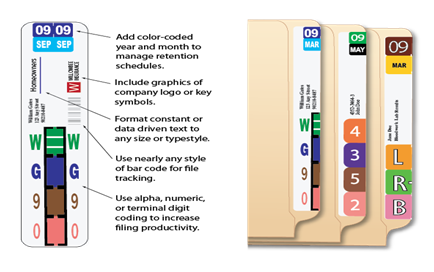
The primary reason color-coding is so effective is rooted in human biology. Humans process visual cues—specifically colors and shapes—significantly faster than we process cognitive data, such as reading text.
Reducing the “Search and Pull” Cycle
In a standard manila filing system, a clerk must stand close to the shelf and read every individual tab to find the correct record. This is a high-cognition task that leads to fatigue and frequent errors. In contrast, color-coded file folders allow the eye to navigate to the general area of the record from several feet away. You don’t “read” the shelf; you “scan” the colors.
How Color-Coding Eliminates Misfiles
The most significant benefit of color-coding is its ability to reveal errors before they become problems. In a traditional system, a misfiled folder is effectively invisible until someone goes looking for it.
Color Clashes as Instant Error Detection
When a folder is placed in the wrong location in a color-coded system, the sequence of color blocks is interrupted. This “visual clash” is so glaring that a records manager can spot a misfile while simply walking past the shelving unit.
Preventing Downstream Compliance Issues
By preventing misfiles, you are also ensuring file tracking for compliance. An audit trail is only useful if the physical asset is where the system says it should be. Color-coding provides the physical “guardrail” that keeps your records room organized, while IoTFileTracker provides the digital oversight.
Side-Tab and Top-Tab Color-Coding Best Practices
The physical orientation of your folders dictates the efficiency of your physical records management.
- Side-Tab (End-Tab) Indexing: This is the gold standard for open-shelf filing systems. By placing the color-coded index on the vertical edge of the folder, every record is visible simultaneously. It eliminates the need to open heavy drawers and maximizes vertical space.
- Top-Tab Indexing: While common in traditional lateral drawer cabinets, top-tab systems are generally less efficient because they hide the index beneath the drawer’s edge. Top-tab color-coding is appropriate only when architectural constraints prevent the use of open shelving.
Color-Coded Filing and Open-Shelf Storage
To achieve maximum file registry efficiency, color-coded folders should be paired with open-shelf or high-density shelving.
Space Utilization Benefits
Open shelving can store up to 50% more files in the same footprint as drawer cabinets by utilizing vertical height. When every folder is color-coded, there is no need for “dead space” to allow for drawer clearance.
Faster Access and Re-Filing
Open-shelf systems reduce the physical strain on staff. There are no drawers to pull or push, and re-filing becomes a simple matter of matching the color pattern. This operational speed is a key driver of ROI in high-volume environments.
Finding Files in Circulation
Even in a facility equipped with RFID file tracking, color-coding remains essential. While RFID can tell you that a file is “somewhere in the legal department,” it is the color-coding that allows a staff member to pluck it from a desk or a temporary bin in seconds. It bridges the gap between digital “proximity” and physical “possession.”
How IoTFileTracker Enhances Color-Coded Filing Systems
At TrackerIoT, we don’t view technology as a replacement for physical organization; we view it as a force multiplier. IoTFileTracker acts as the digital brain for your color-coded registry.
Digital Visibility into File Location
While your eyes use color to find a file on a shelf, IoTFileTracker uses RFID to track that file as it moves through the building. The system records:
- Who checked the file out.
- Where it moved (detected by doorway sensors).
- When it is expected back.
Supporting Audits and Accountability
IoTFileTracker generates automated audit reports. If the digital system indicates a file is on Shelf A, but the color blocks on the shelf show a gap, you have a redundant system for identifying discrepancies. This dual-layer approach ensures absolute records management best practices.
Productivity and Operational Benefits
Combining IoTFileTracker with a color-coded system delivers measurable results:
- Reduced Search Time: Finding a file is 40% faster with color-coding than with plain text.
- Fewer Misfiles: Errors are reduced by up to 90%.
- Improved File Room Efficiency: Staff can manage larger volumes of records with less physical effort.
Industries That Benefit Most from Color-Coded Filing
Government and Public Records: Managing millions of historical documents requires a system that scales without losing accuracy.
Healthcare and Patient Files: In a clinical setting, a missing chart is a patient safety risk. Color-coding ensures clinicians have the data they need, while IoTFileTracker ensures HIPAA compliance.
Legal and Compliance-Driven Organizations: Law firms use these systems to maintain a perfect chain of custody for original contracts and discovery materials.
Combining Color-Coding, Open Shelving, and RFID: The Best-in-Class Model
The ultimate “future-ready” records environment utilizes three pillars:
- Color-Coding: For human-speed retrieval and error detection.
- Open Shelving: For space optimization and ergonomic access.
- IoTFileTracker (RFID): For automated tracking, security, and auditability.
By layering these three strategies, you create a filing environment where files are virtually impossible to lose and effortless to manage.
Conclusion
Color-coded filing remains a best practice because it solves the “human factor” of records management. It turns a dense wall of information into an intuitive, visual map. When this physical excellence is paired with the digital intelligence of IoTFileTracker, organizations achieve total control over their physical assets.