In the high-stakes world of enterprise information governance, the physical file registry remains a vital “source of truth.” Despite the digital revolution, government agencies, healthcare providers, and legal firms continue to rely on physical records for their original signatures, evidentiary weight, and tactile accessibility. However, managing these physical assets at scale presents a significant challenge: the operational cost of inefficiency.
When a file is poorly labeled or improperly tracked, the search costs ripple through an organization. Productivity stalls, legal deadlines are missed, and compliance risks escalate. To solve this, a modern physical record management software must bridge the gap between physical organization and digital visibility. At TrackerIoT, we provide that bridge through IoTFileTracker, a platform that integrates advanced file labeling software with robust RFID file tracking to ensure that every record is accounted for, compliant, and instantly findable.
The Foundation of Effective Records Management
Before a single line of code is written or a tag is scanned, a successful file tracking system requires a solid physical foundation. Technology is an accelerant; if applied to a disorganized filing room, it merely accelerates the chaos.
Best Practices in Physical Organization
Effective physical record management starts with standardized file folders, high-density shelving, and a logical indexing schema (such as alpha-numeric or terminal digit). Optimizing these physical elements—especially using end-tab folders on open shelving—prepares the system for automation. IoTFileTracker complements these best-practice physical registries, transforming a well-organized file room into a high-performance digital asset.
Why File Labeling Is Fundamental
The file label is the primary interface between the physical document and the digital database. It serves as the “identity card” for the folder. Without standardized labeling, a file registry becomes a landscape of inconsistent naming conventions and illegible handwriting.
Human-Readable and Machine-Readable Identification
A modern label must serve two masters: the human eye and the machine scanner.
- Human-Readable: Clear text, bold indexing, and color-coded blocks allow staff to visually locate a file on a shelf in seconds.
- Machine-Readable: Barcodes and RFID inlays allow the file tracking system to log the file’s movement with 100% accuracy without manual data entry.
What Is File Labeling Software?
File labeling software is a centralized tool used to design, index, and print standardized labels across an entire organization. Within IoTFileTracker, the labeling function is not a standalone utility but a core component of the registry.
By centralizing label creation, IoTFileTracker ensures that every department follows the same indexing rules. Whether you are printing small side-tab labels for manila folders or large face-labels for archive boxes, the system ensures that the data on the label matches the data in the database perfectly. This eliminates “ghost files” caused by typos or inconsistent naming.
Barcode Labels for File Tracking
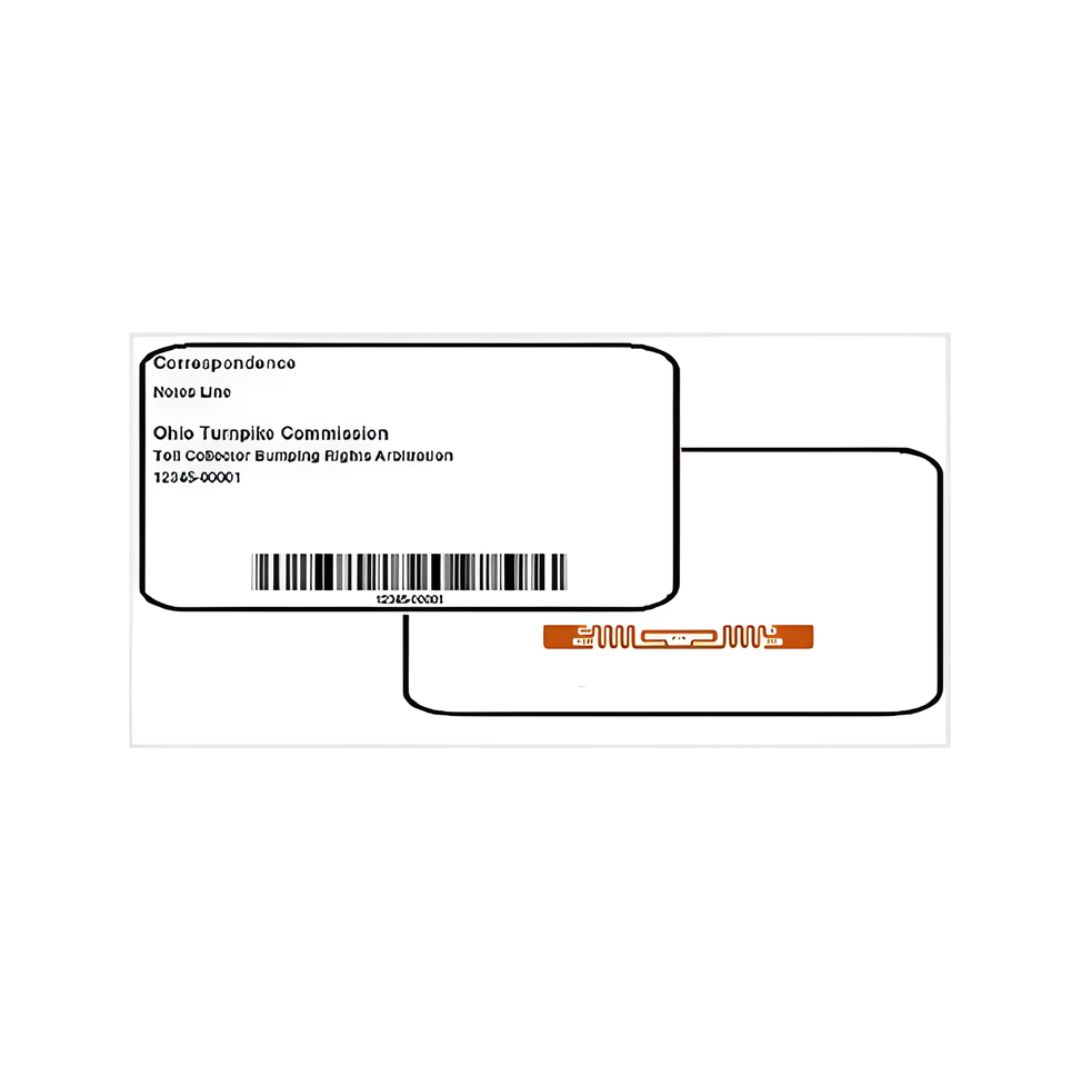
For many organizations, barcode file tracking is the first step toward modernization. It is a proven, cost-effective technology that relies on line-of-sight scanning.
Strengths and Limitations
Barcodes are excellent for “point-to-point” transactions. When a file is checked out at a desk, a quick scan of the barcode updates its status. However, barcodes require a staff member to physically handle each folder and find the label. While highly accurate for individual transfers, barcode systems can be labor-intensive when performing large-scale audits or searching for a misplaced file among thousands of folders.
RFID Labels for Advanced File Tracking
To achieve the highest level of file room efficiency, organizations are increasingly turning to RFID file tracking. Unlike barcodes, RFID (Radio Frequency Identification) does not require line-of-sight.
Passive, Real-Time Tracking
RFID-enabled labels contain a tiny chip and antenna. This allows IoTFileTracker to “interrogate” the environment.
- Bulk Scanning: A handheld scanner can read dozens of files in a single pass, turning a three-day inventory task into a thirty-minute walk-through.
- Long-Range Detection: Fixed RFID sensors at doorways can track files as they leave the room, automatically logging the movement without any human intervention.
- Rapid File Finding: If a file is lost, the “Geiger counter” mode on a portable scanner can lead a staff member directly to the folder, even if it is buried under a stack of other documents.
Barcode vs. RFID File Tracking
Choosing the right technology depends on the organization’s specific volume and security needs.
| Feature | Barcode Tracking | RFID Tracking |
| Scanning | Line-of-sight (One by one) | Proximity (Bulk scanning) |
| Manual Labor | High (Requires handling) | Low (Automated) |
| Cost per Label | Very Low | Moderate |
| Search Capability | Manual/Visual | Automated “Find” mode |
| Exit Security | No | Yes (Doorway Alarms) |
Many IoTFileTracker users adopt a hybrid approach: using barcodes for legacy archives and RFID for active, high-circulation records where visibility is critical.
Portable Scanners and File Inventories
The greatest threat to a file tracking system is “database drift”—the phenomenon where the digital record no longer matches the physical reality of the shelves.
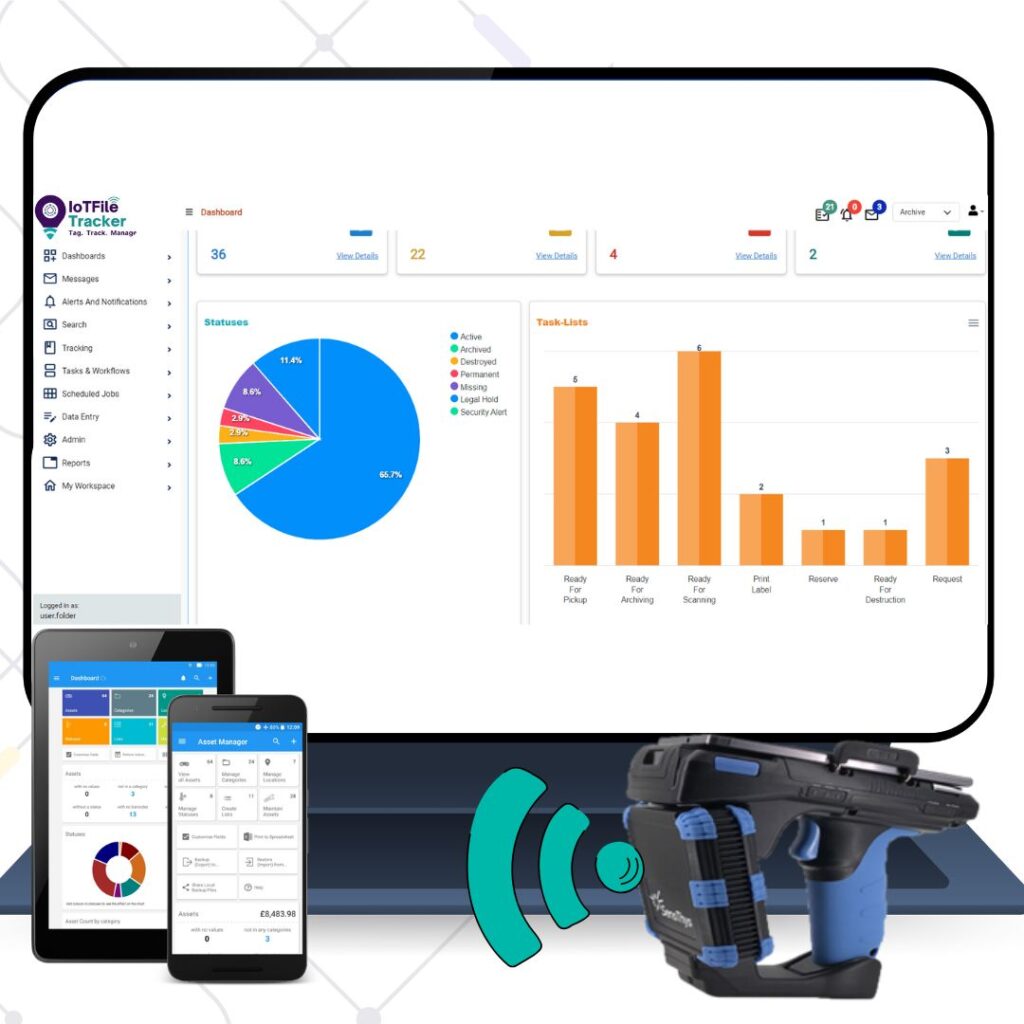
IoTFileTracker utilizes portable scanners to simplify audits and inventories. By performing regular “sweeps” of the file room, staff can identify misfiled folders or files that were moved without being checked out. These audits ensure that the database remains the “Source of Truth,” which is vital for file tracking for compliance in regulated industries.
Real-Time File Movement Visibility
A file’s value is often highest when it is in circulation. IoTFileTracker tracks the record throughout its entire lifecycle, from labeling to archiving.
By tracking files leaving and returning to the registry, the software provides a clear picture of “Who has what.” This reduces the time wasted on “all-staff” emails asking if anyone has seen a specific case file or patient chart. If a file is in the legal department, the system shows it in real-time.
How IoTFileTracker Integrates Labeling and Tracking
The true power of IoTFileTracker is the seamless integration of labeling and location tracking. In most legacy systems, these are two separate processes. In our platform:
- Index: You enter the file data into the registry.
- Print: The system generates a label with the correct barcode or RFID encoding.
- Track: The system makes the file live the moment it prints the label, enabling tracking via handhelds or fixed gateways.
This “one-system” approach reduces manual work, eliminates data silos, and significantly reduces the chance of human error.
Productivity Benefits for File Rooms and Office Staff
Implementing IoTFileTracker delivers a measurable ROI in three key areas:
- Faster Retrieval: Staff can find the exact folder they need in seconds rather than minutes.
- Fewer Lost Files: Proactive tracking and doorway alerts prevent files from “disappearing” into unauthorized areas.
- Reduced Labor and Rework: Eliminating manual logs and streamline audits allows records managers to focus on high-value information governance rather than clerical searching.
Best Practices for Implementing File Labeling and Tracking
Transitioning to an automated system requires a strategic approach:
- Standardization: Enforce a single indexing and labeling standard across the organization.
- Phased Rollout: Start by tagging active, high-value files before moving to long-term archives.
- Training and Change Management: Ensure that staff understand how to use the portable scanners and the importance of checking files in and out.
Conclusion
File labeling and file tracking are two sides of the same coin. A label provides the identity, but the software provides the visibility. By integrating these functions into a single, cohesive platform, IoTFileTracker turns the physical file registry into a modern, efficient, and compliant operation.
In the pursuit of operational excellence, physical file tracking should not be a burden—it should be a competitive advantage. With TrackerIoT, your organization can move forward with the confidence that every record is exactly where it needs to be.