
In the high-stakes environment of enterprise records management, the “Chain of Custody” is the absolute baseline for operational integrity. For government agencies, healthcare systems, and legal firms, the ability to prove who had a specific document at a specific time is not just a matter of convenience—it is a legal and regulatory necessity. Yet, many organizations still rely on antiquated paper sign-out logs that are prone to illegibility, loss, and manipulation.
To address these vulnerabilities, modern records centers are transitioning to digital-first workflows. By integrating electronic signature pads with the IoTFileTracker platform, organizations can transform a simple file hand-off into a secure, immutable, and fully auditable event. This synergy of hardware and software backs every secure file transfer with a “digital handshake” that enforces total accountability.
Why Custody Verification is Critical in Records Management
The moment a file leaves a secure file room, its risk profile increases. Without a rigorous verification process, files can enter a “black hole” of accountability. If someone misplaces a sensitive case file or patient record, the first question an auditor or investigator will ask is: Who last took possession of this record?
Limitations of Paper Sign-Out Logs
Traditional paper logs are the weakest link in the chain of custody. They suffer from several systemic flaws:
- Illegibility: Signatures are often unreadable, making it impossible to identify the recipient months later.
- Lack of Context: A paper log doesn’t show the real-time status of the file to the rest of the organization.
- No Validation: There is no mechanism to verify if the person signing is actually authorized to receive that specific classification of document.
- Audit Fragility: Paper logs are easy to misplace or destroy, leaving the organization without a defense during a compliance review.
IoTFileTracker eliminates these vulnerabilities by digitizing the point of transfer, replacing the pen-and-paper method with a high-fidelity electronic signature pad workflow.
What Is an Electronic Signature Pad?
An electronic signature pad captures handwritten signatures in a digital format using a specialized peripheral device. While it may appear simple, its role in a secure file transfer is profound. It serves as the physical interface for “Non-Repudiation”—the legal principle that ensures a person cannot deny the authenticity of their signature on a record.
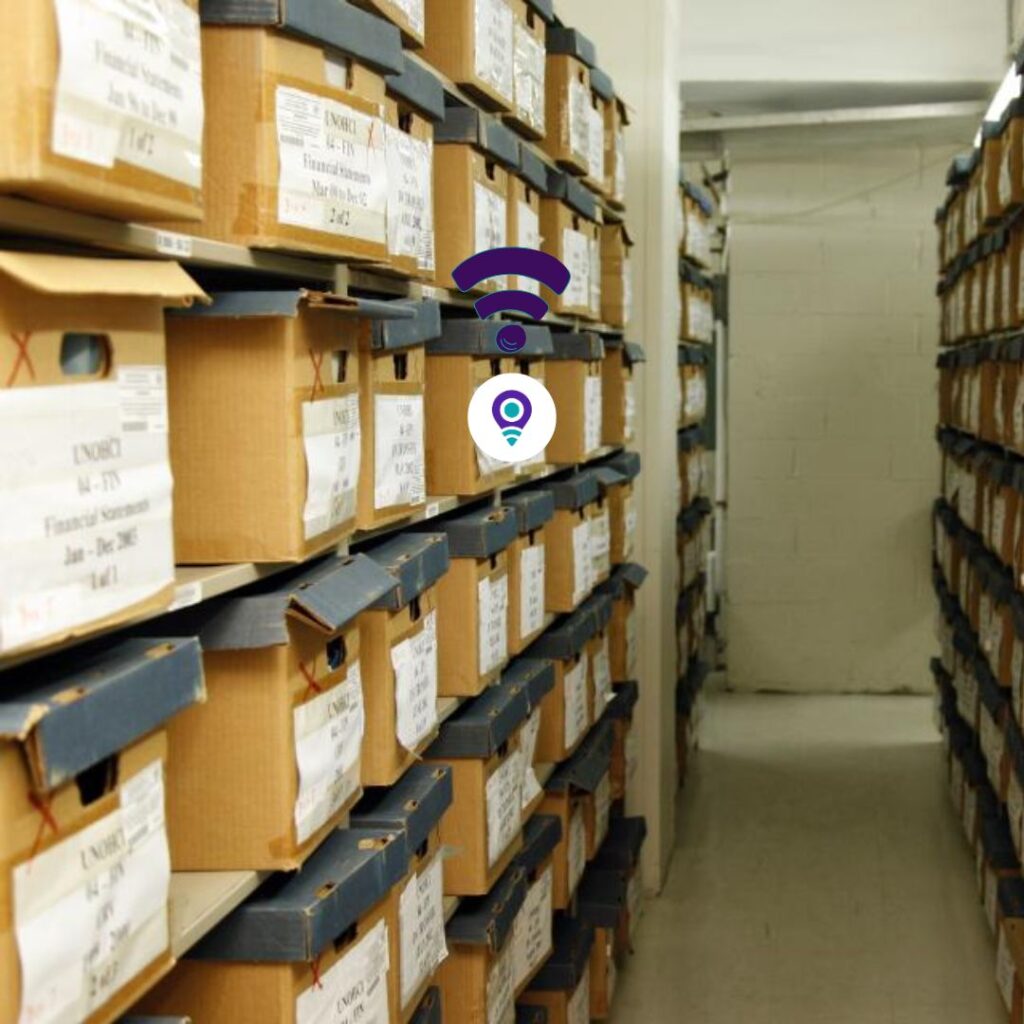
In a modern records center, the signature pad is the final gatekeeper. It ensures that the transition of responsibility is a deliberate, conscious act. By capturing a high-resolution digital image of the signature and embedding it directly into the IoTFileTracker database, the system creates a permanent link between the physical RFID-tagged folder and the verified human recipient.
The Role of Electronic Signatures in Chain-of-Custody
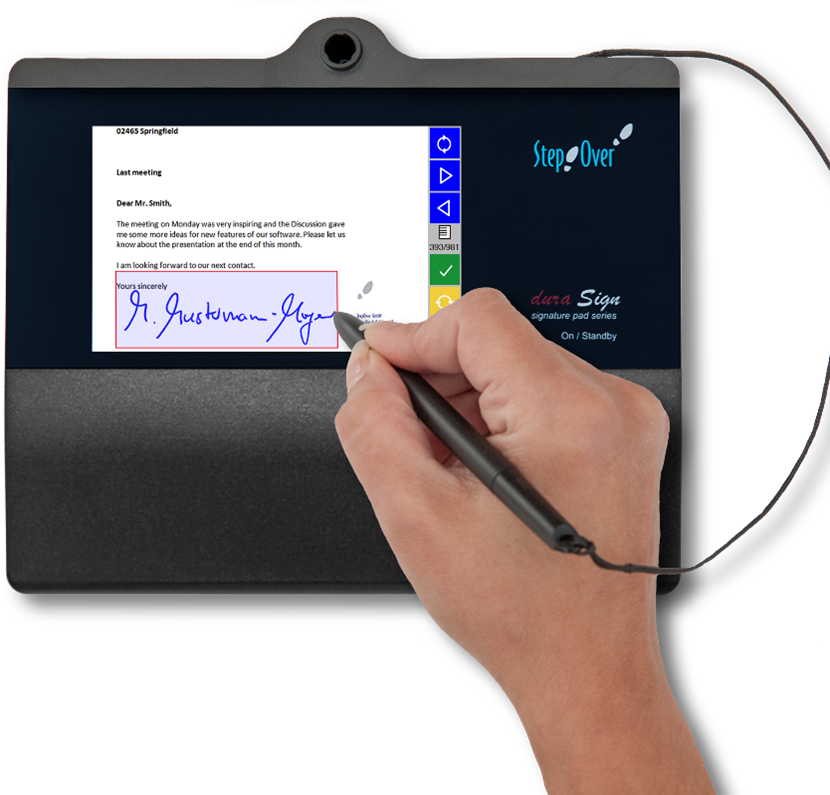
Chain of custody tracking is only as strong as the evidence supporting it. In a courtroom or a regulatory audit, “the system says he took it” is often insufficient. However, providing a time-stamped record accompanied by a captured signature provides a nearly indisputable level of evidence.
Accountability and Non-Repudiation
When a recipient signs an electronic pad, they are legally acknowledging receipt and assuming custody. This process discourages the casual “borrowing” of files and ensures that staff members treat physical records with the same level of security as digital assets. For records management security, this psychological and legal “weight” is essential for maintaining order in high-volume environments.
How Electronic Signature Pads Work with IoTFileTracker
The integration between the hardware and the IoTFileTracker platform delivers a seamless and operationally practical experience.
USB-Connected Signature Pads
Typically, the signature pad is connected via USB to a workstation at the records check-out counter. When a file is pulled for issuance, the records manager scans the file’s RFID tag. IoTFileTracker instantly identifies the file and prompts the recipient to sign.
The software not only records the signature but also manages the entire context of the event, ensuring it ties the signature directly to the correct file ID, user profile, and exact transaction metadata.
Validating Files at Transfer
One of the unique features of the IoTFileTracker workflow is the “Verification Screen.” Before the recipient signs the pad, the records manager’s monitor (and often a secondary display for the recipient) shows exactly what is being transferred.
Recipient Confirmation Before Signing
The system displays:
- File Identifiers: The unique name and number of the folder.
- Descriptions: What the file contains (e.g., “Active Litigation – Case 402”).
- Timestamp: The exact date and time of the issuance.
This ensures that the recipient isn’t “signing blind.” They are confirming that they have the specific files listed on the screen in their physical possession. This step is a critical component of document accountability, preventing the common error of checking out the wrong folder in a stack of similar-looking files.
Automatic Location Updates After Signing
In a manual system, after someone signs a logbook, a clerk might have to go back into a computer system to update the file’s location—a process prone to data entry errors and delays.
With IoTFileTracker, the signature is the trigger for automation. The moment the user presses the “Accept” button:
- Custody Update: The file’s status changes from “In Storage” to “Out to [Recipient Name].”
- Location Mapping: The “current location” is updated to the recipient’s assigned office or department.
- Real-Time Visibility: Anyone else in the organization searching for that file through the file tracking system will instantly see who has it.
This eliminates manual data entry and ensures that the “Source of Truth” is always current.
Audit Trails and Custody History
Every issuance and return managed by IoTFileTracker contributes to a comprehensive, chronological audit trail.
Capturing Time-Stamped Signature Records
The system logs every touchpoint. When a file is issued, returned, and issued again, IoTFileTracker records a history of every person who signed for it.This audit trail remains immutable, and users cannot alter or delete it, ensuring its integrity for years to come.
Printing and Using Chain-of-Custody Reports
When it comes time for an audit or an investigation, IoTFileTracker transforms these individual signatures into powerful reports. Records managers can generate a “Chain-of-Custody Report” for a single file, a specific date range, or a particular user.
These reports demonstrate the full lifecycle of the record. They show a clear path of possession, proving that the organization has maintained file tracking for compliance at every stage. This level of transparency is often the difference between a successful audit and a costly compliance failure.
Security and Compliance Benefits
Implementing electronic signature pads offers immediate ROI in the form of risk reduction:
- Reduced Disputes: The “he said, she said” of missing files is eliminated.
- Improved Governance: It enforces organizational policy at the point of action.
- Transparency: Stakeholders have confidence that physical records are being handled with professional rigor.
- Compliance Readiness: It specifically satisfies the “Access Control” and “Audit Trail” requirements of HIPAA, CJIS, and Sarbanes-Oxley.
Industries That Benefit from Electronic Signature Pads based tracking
Government and Public Records: Managing sensitive citizen data or investigative evidence requires a system where the hand-off is as secure as the storage.
Healthcare and Patient Documentation: Hospitals use IoTFileTracker to always account for physical patient charts and clearly track who accessed Protected Health Information (PHI).
Legal and Regulatory Environments: Law firms protect “attorney-client privilege” by ensuring that case files are only in the hands of authorized legal teams, with signatures to prove it.
Enterprise Records Departments: Large corporations manage intellectual property and HR records, using electronic signatures to protect their most valuable internal assets during internal audits or transfers.
The Future of Secure File Transfers
The future of records management security lies in the further convergence of physical and digital identities. We are moving toward a world where the signature pad might work alongside biometric verification or mobile-app-based “custody acceptance” using encrypted digital keys. IoTFileTracker is built on a scalable architecture designed to adapt to these changes. As the standards for document accountability evolve, our platform remains the central hub for ensuring that your physical records are never truly “out of sight.”
Conclusion
In the pursuit of total compliance and operational efficiency, “good enough” tracking is no longer an option. Electronic signature pads provide the definitive proof of possession that manual systems lack, creating a culture of accountability within your organization.By choosing IoTFileTracker, you are not just buying a software platform; you are implementing a sophisticated security framework that protects your records, your staff, and your reputation.