
In the age of rapid digital transformation, the physical file registry is often viewed as a legacy burden. However, for many government agencies, healthcare systems, and legal firms, physical records remain an indispensable reality of high-stakes operations. The true burden is not the paper itself, but the lack of a modern filing system design.
A poorly designed file registry leads to “lost file” syndrome, plummeted productivity, and significant compliance risks. Conversely, an optimized system—one that combines physical best practices with a sophisticated file tracking system—turns an archive into a high-performance asset. At TrackerIoT, we believe that the foundation of any successful records operation is a well-designed registry managed by IoTFileTracker.
What Is a Filing System and File Registry?
A filing system is the physical architecture of your records, encompassing the folders, the shelving, and the organizational logic (alpha, numeric, or terminal digit). A file registry, however, is the “brain” of that architecture. It is the centralized system—traditionally a paper log, but now a digital platform—that monitors the lifecycle, location, and status of every record.
An effective file registry system requires both elements to work in harmony. The physical design ensures that records are stored for maximum accessibility, while a platform like IoTFileTracker provides the real-time visibility needed to manage circulation, prevent losses, and enforce file tracking for compliance.
The Role of File Folders in Records Management
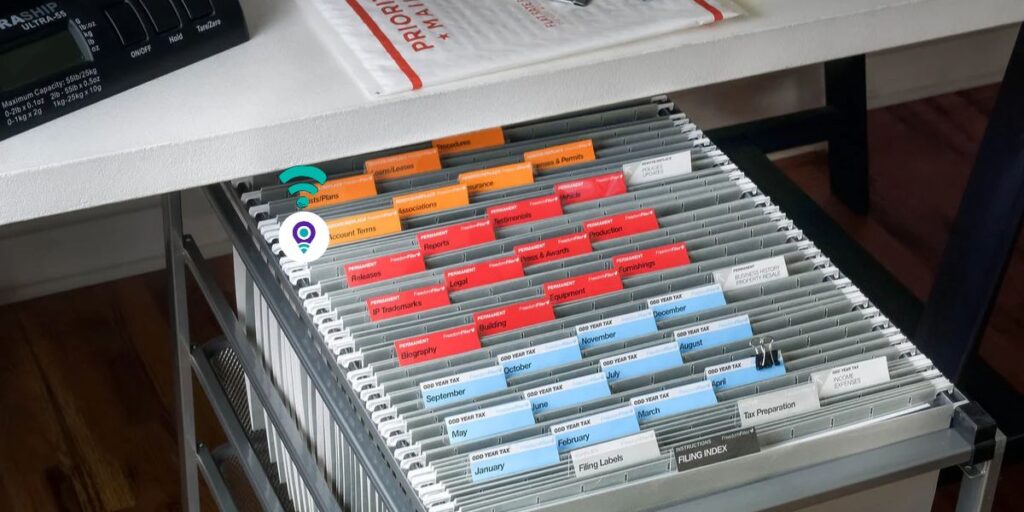
Successful filing system design begins with the folder. In a high-churn environment, the folder is more than a container; it is a protective shell that must withstand decades of handling.
Durability and Construction
Quality folders should be constructed from heavy-duty stock (such as 11-point or 14-point Manila or Kraft) to prevent sagging and tearing. When folders collapse on the shelf, they hide neighboring folders, leading to immediate retrieval failures.
End Tabs vs. Top Tabs
In a modern, productive registry, end-tab (side-tab) folders are the standard. Unlike top-tab folders, which are designed for deep drawer cabinets that hide records, end-tab folders are designed for open shelving. They allow the index to be visible at all times, facilitating “at-a-glance” searching and high-speed RFID file tracking.
Folder Indexing, Labeling, and Color-Coding
How a folder is identified is the single greatest factor in registry productivity. Records management best practices dictate a shift from cognitive identification to visual recognition.
Why Side-Tab Indexing Is Best Practice
By placing the identification label on the vertical side tab, you eliminate the need to open drawers or lift folders to find a record. Every file in the row is visible simultaneously.
The Power of Color-Coded Filing Systems
Human brains process colors significantly faster than they read text or numbers. By using color-coded filing systems, where specific colors represent digits or letters, you create solid blocks of color on your shelves.
- Visual Error Detection: A misfiled folder becomes a “clash” in the color pattern. A red folder in a block of blue is a glaring error that can be spotted from across the room.
- Eliminating Misfiles: Color-coding reduces the cognitive load on staff, allowing them to file and retrieve records with nearly 100% accuracy.
Organizing Documents Within File Folders
Visibility shouldn’t end when the folder is pulled from the shelf. To maintain secure records management, the internal organization of the folio is vital.
Using fasteners, partitions, and dividers allows you to categorize documents (e.g., correspondence, lab results, contracts) within a single folder. When combined with IoTFileTracker, you can even track individual “child” documents within the “parent” folder using folio-level RFID tags, ensuring that critical documents never leave the folder without authorization.
Shelving and High-Density File Storage
Space is often the most expensive component of a records center. Traditional four-drawer lateral cabinets are inefficient, occupying large footprints and offering limited access.
Drawer Cabinets vs. Open Shelving
Open-shelf filing allows for vertical expansion, often using 7 or 8 tiers of records. This design can store up to 60% more files in the same floor space as drawer cabinets.
High-Density File Shelving
For maximum optimization, high-density file shelving (mobile carriages on tracks) eliminates the need for multiple permanent aisles. You only open the aisle you need. These systems, when integrated with IoTFileTracker fixed RFID antennas, create a “Smart Room” where the software can monitor thousands of files in real-time within a condensed footprint.
Why Open-Shelf Filing Improves Productivity
Switching to an open-shelf design managed by a file tracking system delivers immediate operational benefits:
- Faster Access: No drawers to open and close.
- Increased Density: More records per square foot reduces the need for off-site storage.
- Ergonomics: Staff move more naturally and can view entire sections of the registry at once, reducing the physical strain and motion associated with deep drawers.
The Importance of a Computerized File Registry
Manual tracking systems—like paper out-cards—fail because they depend on human memory and perfect compliance. At scale, manual registries turn into “black holes” that swallow files while failing to update their current locations.
A computerized file registry system like IoTFileTracker provides the “Source of Truth.” It records:
- Who has the file (Custody).
- Where the file is (Location).
- When it is due back (Retention/Circulation).
How IoTFileTracker Enhances Filing Systems
IoTFileTracker is the technology layer that brings a physical filing system into the modern IoT era. It uses RFID file tracking to automate the most labor-intensive parts of records management.
Monitoring Files in Circulation
As a folder leaves the open shelf, the system detects its movement. If a file is taken from the registry to an unauthorized department, IoTFileTracker triggers an alert.
Reducing Search Time and Lost Files
With a handheld RFID reader, a clerk can “audit” an entire shelf in seconds. Instead of reading every label, they simply wave the scanner, and the software confirms that all files are present—or highlights exactly which one is missing.
Productivity and Cost Benefits
Optimizing your registry with IoTFileTracker leads to a measurable ROI:
- File Room Efficiency: Staff can retrieve and re-file records 50% faster than in traditional systems.
- Office Worker Productivity: Employees spend less time waiting for information and more time on high-value tasks.
- Reduced Labor Waste: Eliminating the hours spent searching for “misplaced” files significantly reduces operational overhead.
Industries That Benefit Most from Optimized File Registries
- Government: Managing vast public record archives and investigative files with total transparency.
- Healthcare: Ensuring patient charts are available at the point of care while maintaining HIPAA compliance.
- Legal: Protecting the chain of custody for discovery materials and original contracts.
- Corporate: Managing HR records, intellectual property, and financial archives across multiple campuses.
Future of Filing Systems and File Registries
The future of the file registry is a hybrid of physical excellence and digital intelligence. We are moving toward a world where the shelf itself is “aware” of its contents 24/7. By combining color-coded filing systems for human speed and RFID file tracking for machine accuracy, organizations create a redundant, failsafe environment for their most important information.
Conclusion
Filing system design is the foundational architecture of information governance. Without a well-designed physical structure, technology struggles to fill the gaps. However, when you combine Best-Practice physical filing with the automated power of IoTFileTracker, you achieve the pinnacle of records management: a system that is efficient, secure, and fully accountable.